
Payment teams are drowning in data.
A typical payment manager might spend 10–20 hours per week analyzing dashboards from multiple processors, compiling reports, and hunting for patterns in transaction data.
Payments are simultaneously the most critical and most under-resourced part of the business. Often, a single person manages the entire payment journey, and that person spends their days firefighting rather than strategizing.
AI has the power to change this.
At Primer, our vision is clear: give payment teams their time back, provide expert guidance for complex decisions, and uncover revenue opportunities hidden in the data.
But what does "AI payment optimization" actually mean? Can it lead to genuine innovation, or just another technology trend being oversold? And perhaps most importantly for payment professionals: how will AI impact your role?
This article shares Primer's vision for building intelligent payment assistants that augment, not replace, payment teams.
Book a demo to see Primer AI Companion for yourself.
Our vision: AI as your payment team's intelligent teammate
When we think about AI payment optimization at Primer, the goal isn't to replace payment teams. It’s to give them a teammate who handles operational burden while they focus on strategic initiatives.
Instead of buying another tool, imagine hiring a payment assistant who works around the clock.
When we were considering how AI can help merchants, we realized it had to do three key things:
- Continuous monitoring and insights: An AI teammate could work in the background, constantly analyzing payment performance across all processors and payment methods, compiling automated reports that highlight critical trends you might miss in the noise.
- Strategic guidance based on payment expertise: Beyond monitoring, an AI assistant could provide recommendations grounded in payment knowledge, like which payment methods to add for a new market, why authorization rates are underperforming, or how to best implement 3DS.
- Augmentation but not replacement: You always stay in control, with AI recommending and suggesting but not executing changes without oversight. This allows you to remain in full control.
Introducing Primer AI Companion
At Primer, we recently announced AI Companion, built to help payments teams better manage operational complexity. It represents our vision for augmented payment teams, where AI continuously analyzes payment performance and provides contextual guidance. While AI Companion is currently in the prototype stage, it reflects the direction Primer is building toward.
Let’s dive in.
AI Companion is not just another chatbot
This isn't another AI chatbot that waits for questions. It's designed to work as a proactive teammate. The distinction matters. Chatbots are reactive interfaces. You ask, and they respond.
When you hire an employee, you don't expect them to sit idle until you ask a question. You expect them to work independently in the background, create valuable reports, identify opportunities, and proactively share insights. You can reach out when you need specific help, but they're also delivering value continuously.
Generic LLMs lack payment expertise. They can’t properly query payment systems and they don't understand the nuanced context of processor performance, decline codes, and market requirements. There’s also a high risk of hallucinations.
How it works in practice
You begin by training your AI Companion on your objectives, similar to onboarding a new team member. You tell it what you're trying to achieve: expand to new markets, reduce payment processing costs, increase authorization rates, or minimize failed payments. It learns your specific payment setup, your connected processors, your active payment methods, and your strategic priorities.
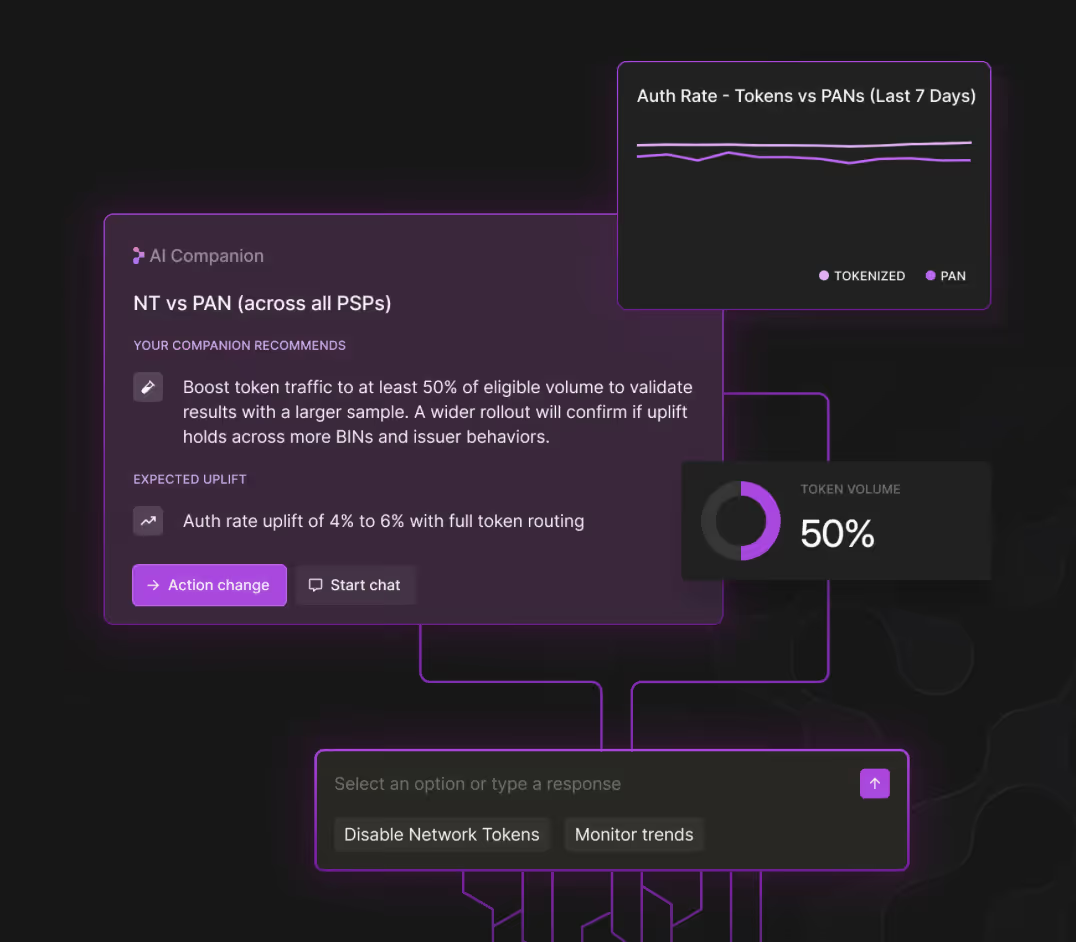
Once configured, AI Companion works in the background, continuously analyzing payment data across all your connected processors. It creates automated reports, identifies concerning trends or promising opportunities, and surfaces insights that might get lost in daily operational noise.
Currently, Primer is prototyping capabilities around specific high-value areas like network tokenization performance, helping merchants understand where token-based payments are delivering better authorization rates or lower fees.
Chat interface for specific analysis
The chat interface provides a way to get specific analysis on demand. You might ask:
- "Why did authorization rates drop in the UK this week?"
- "What payment methods should I consider for our German expansion?"
- "How does our Stripe performance compare to Adyen for European transactions?"
Instead of digging through multiple processor dashboards and piecing together the answer yourself, AI Companion provides it based on your actual payment data.
Recommendations and guidance
Beyond answering questions, AI Companion offers recommendations and guidance. It might suggest strategic opportunities based on your data, provide payment expertise for new markets, explain best practices for specific scenarios, and help prioritize initiatives.
For instance: "Based on your UK expansion plans, you should implement 3DS in these specific payment flows to comply with Strong Customer Authentication requirements."
You stay in control
Here's the critical safeguard: AI Companion recommends, it doesn't act.
You review and approve any changes. You remain accountable for all payment decisions. There are no automatic modifications to payment flows or configurations. Trust builds gradually as recommendations prove valuable.
The future of payment teams: augmented, not replaced
At Primer, we're building toward the future with AI Companion. Our commitment is to put payments in the hands of payment teams. This will free up your time to innovate and optimize, rather than drown in data.
If your payment team spends more time analyzing data than developing strategy, if you're expanding to markets where you lack local payment expertise, or if you want to shift from firefighting to proactive optimization, AI payment optimization could change how your team works.
Book a demo to see how Primer AI Companion can help your team monitor performance and act faster.
Wondering how the AI shift could change the way customers discover products, check out and pay? Read our guide: What is agentic commerce, and how should merchants prepare?
Frequently asked questions (FAQ) about AI payment optimization
Will AI payment optimization replace my payments team?
At Primer, we believe the goal of AI payment optimization is augmentation, not replacement.
AI can reduce the operational burden that eats up hours each week, such as pulling reports, monitoring performance in near real-time, and spotting patterns across processors, payment options, and markets. That gives your team time back to focus on strategy, the customer experience, and improving the overall payment experience.
You stay in control. AI should recommend actions and help streamline workflows, but people still own the decisions that affect customers, risk, and revenue.
What is the difference between machine learning and AI in payment optimization?
Machine learning is typically pattern recognition. It uses algorithms trained on historical data to predict outcomes like fraud risk or likelihood of failure. This is widely used for fraud prevention, but it can also create false positives that block legitimate transactions.
AI payment optimization is broader. It can combine machine learning and large language models to do three things:
- Explain what is happening across your payments ecosystem, not just flag anomalies
- Connect performance to outcomes like approval rates, acceptance rate, and conversion rates
- Recommend actions across payment routing, retry strategies, checkout flows, and operational workflows
In other words, machine learning is often focused on detection. AI optimization is focused on detection, explanation, and guidance.
What are the most common use cases for AI-driven payment optimization?
The highest value use cases tend to be operational and performance-focused:
- Payment routing recommendations, for example, routing by issuer, BIN, or card networks to improve approval rates
- Smarter retry strategies to recover revenue without increasing fraud risk
- Identifying drivers of false declines and reducing friction at checkout
- Early warning signals for performance issues across processors and global payments flows
- Risk insights that improve secure payment decisions without over-blocking
- Dispute insights to help you manage chargebacks
- Forecasting and prioritization using predictive analytics, for example, where changes will have the biggest lift
How can AI improve approval rates without increasing fraud or chargebacks?
This is the balancing act. Higher approval rates are not the same as approving everything.
Good AI-assisted approaches look for ways to increase approvals while still protecting against payment fraud, such as:
- Reducing false declines by approving more legitimate transactions, not more fraud
- Better decision-making around risk signals to reduce false positives
- Payment routing optimization that accounts for issuer behavior and card networks
- Recommending incremental changes to workflows that improve performance without loosening controls
The point is to improve outcomes without degrading trust or increasing disputes.
Is AI payment optimization available today, or is it still future technology?
It is available today, but most implementations are still early.
Many payment solutions already use machine learning behind the scenes, especially for fraud prevention. What is newer is AI that supports payment teams across the broader stack, including monitoring, analysis, recommendations, and workflow support. Some vendors describe this as AI-powered or AI-driven optimization, but quality varies. It is worth asking what is actually automated versus what is simply a new interface.
%20(1).png)
.avif)