
2025 was a momentous year for Primer in so many ways.
We processed a record number of payments, delivered meaningful performance improvements, and evolved the platform to support a wider range of use cases.
It felt like a turning point in our journey; a transition into the next chapter, or as our CEO, Gab, put it, the next evolution of Primer. And it was all inspired by asking: What if?
From a product and engineering perspective, outside of innovation and our new product releases, scale became the defining theme of the year.
As merchants routed a growing share of their payment volume through Primer and adopted more of our products, the scale we were already building for became tangible.
Scale didn’t change our approach so much as it tested it.
To deliver the reliability and performance expected required us to continue to invest in enterprise-grade foundations, tightening how we operate the platform, and ensuring that every new capability reinforced the core rather than adding complexity.
And we delivered. Today, merchants route an average of 97% of their payments through Primer, and they’re using more of the platform than ever before. We don’t see this as merchants simply 'using more features,' but as evidence that when products are designed to work together, their value compounds.
Taken together, these changes reflect how Primer matured over the past year, not just in what we shipped, but in how the platform is used, relied on, and extended as scale increases.
Extending the value of Primer deeper into the payments value chain
For the last five years, we’ve focused on building payments infrastructure that gives merchants control and flexibility over how they manage, process, and reason about payments. But the ambition was never limited to the transaction itself. A payment is only one moment in a much longer, more fragmented money movement journey.
In early 2025, we took a step further along that journey with the full launch of our Reconciliation product. It addressed a real and persistent pain for finance teams by bringing clarity to what had long been opaque: a unified, standardized view of fees and net payouts for every transaction, across all Payment Service Providers (PSPs).
It was an illuminating process for all of us involved that brought us into much deeper conversations with finance and treasury teams. And one theme kept coming up: Foreign Exchange (FX) costs. We were repeatedly told that costs were high, inconsistent, and difficult to reason about until funds had already moved.
So we decided to do something about it and launched Global Accounts.
Although always in our long term plans, Global Accounts wasn’t on our roadmap at the beginning of the year. But, thankfully, agility is one of our biggest strengths at Primer, allowing us to pivot where we see opportunities, and a small, focused team delivered it in a matter of months.
Learn more about Global Accounts and see it in action.
The feedback has been great, and we’re excited to see this new product area really establish itself in 2026. But it’s important to stress that Global Accounts is just the beginning.
Our ambition is to provide a single interface to control the end-to-end money movement journey, from checkout to settled funds movement.
We plan on extending our capabilities to solve a plethora of challenges finance and treasury teams face, which we’re uniquely positioned to unify into a single platform across the end-to-end transaction value chain.
Giving merchants more tools to actively optimize their payments
At the same time as expanding into new parts of the transaction value chain, we continued to challenge ourselves to build on Primer’s core by giving merchants more tools to optimize payments, turn them into a growth lever, and maximize ROI.
This started at the checkout, with the introduction of our new Checkout.
The product was first ideated in 2024, when it became clear that our two existing checkout integration options, Drop-In and Headless, were being treated as a trade-off between speed and flexibility.
With our new Checkout, merchants don’t have to make this trade-off. Built on a modular, low-code architecture, every part of checkout, from form fields to buttons, can be added, removed, styled, and arranged independently. This gives our merchants the ability to build a highly performant checkout that precisely fits their brand and flows with minimal engineering effort.
And with the inclusion of checkout-level signals in our Observability platform coming soon, we’re giving our merchants everything they need to build the highest-converting checkout.
Fallbacks, our solution that allows merchants to retry and recover failed payments, was another area we pushed further last year.
More than 95% of merchants running two or more PSPs use Fallbacks, giving us a rich set of real-world data on how fallback logic performs in production. Analyzing that data highlighted where our original fallback logic could go further.
We refined the fallback logic through targeted exploration and production experiments with some of our merchants, validating the changes in live environments and delivering up to a 3× improvement in recovery rates over the initial implementation.
The result is that some merchants now recover more revenue each month through Fallbacks than they pay us. That’s a meaningful milestone. It reinforces a belief we’ve held from early on: payments shouldn’t just be a cost to manage, but a system that businesses can actively optimize, and in this case, one that delivers a positive ROI.
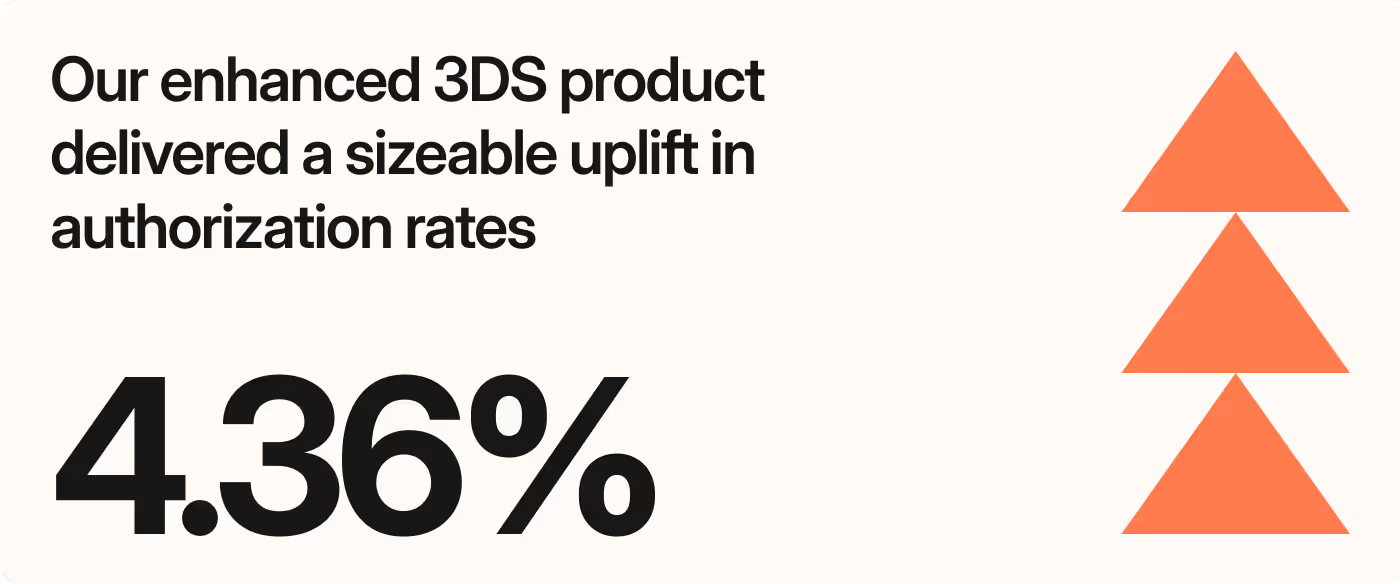
Over the past year, we also strengthened our product with additional underlying providers, improving redundancy, expanding scheme coverage, and unlocking new capabilities. This allows merchants to design and test more sophisticated 3DS strategies directly in Primer Workflows, and for some, realize authorization rate improvements of over 4%.
Connecting a fragmented payments ecosystem
Payments are inherently fragmented. A single transaction can touch five to seven different providers, each with its own APIs, documentation quality, and operational constraints. For merchants, that fragmentation translates into a complex payment stack that is expensive to build, painful to maintain, and slow to evolve.
Having shipped and maintained over 140 integrations used in production globally, we’ve experienced that complexity firsthand. Building the abstraction layer on behalf of merchants exposed just how much effort goes into keeping integrations functional as providers evolve, standards change, and edge cases accumulate. And the problem isn’t getting better. As more specialized solutions emerge across the value chain, fragmentation continues to increase.
As more providers look to connect through Primer, we’ve reached the point where scaling means rethinking how those integrations are built. So we asked ourselves: What if we could flip the script? What if anyone could build and manage their own integration into Primer?
Primer for Partners is the answer to those questions.
We started R&D in mid-2023 with a clear ambition: to rethink how integrations should work. The core shift was architectural in that integrations needed to become configuration, not code. That meant encoding conditional logic, field-level transformations, and provider-specific behavior in a way partners could own directly in a no-code interface.
It was a hard problem to solve, and if we’re honest, one that didn’t seem feasible at the outset. But we thought taking this approach was necessary to deliver the best possible experience for both merchants and partners, and that effort ultimately paid off.
In early 2025, we consolidated this work into a dedicated Partners team. By September, we dogfooded the system and built a PSP integration in under an hour, without writing code. That moment not only validated the approach, it felt significant.
Today, merchants and partners can onboard and collaborate without technical friction. Partners can connect into Primer in clicks, not code, and distribute broadly to all our merchants. And we’re going beyond solving for just distribution for partners. Our goal is to build a true two-sided platform that gives partners the tools they need to create more value for their merchants.
Learn more about Primer for Partners and see it in action.
Taking an intentional approach to AI
People don’t want AI for its own sake. They have specific problems to solve. And just as importantly, AI isn’t the right tool for every problem.
We’ve tried to be disciplined about that. Rather than starting with the technology, we focused on identifying areas where AI could meaningfully reduce complexity for merchants. One of the clearest needs we saw was around understanding and analyzing payments data. Merchants sit on large volumes of fragmented information, but turning that data into insight usually requires specialist tooling, time, or expertise.
That’s what led to Primer AI Companion. It’s designed to help merchants interrogate their data and answer practical questions without needing to become experts in analytics or payments reporting.
.avif)
Primer is well-positioned to do this because of the platform we’ve already built. Payments flowing through Primer span multiple PSPs, schemes, issuers, geographies, and payment methods, all normalized into a single format. That gives us two things at once: a detailed view of how an individual merchant’s setup behaves, and a broader context for how similar configurations perform elsewhere. Most teams only ever see one side of that equation.
Data alone isn’t enough, though. What matters is how it’s interpreted and applied. Years of working closely with merchants have shaped how we think about payment problems, what’s actionable, what’s noise, and where automation genuinely helps versus where it creates risk.
Today, Companion focuses on retrospective analysis: helping merchants understand what’s happened and why. Over time, we see a much broader role for AI in payments, suggesting experiments, identifying configuration changes that will improve performance, and reconfiguring payment processing logic dynamically as conditions change.
The long-term goal is an always-on agent that can help continuously tune a merchant’s payment setup, with merchants deciding how much control to delegate. Our job is to make that possible in a way that’s transparent, controllable, and grounded in how payments actually work.
Increasing platform stability and enterprise readiness
As more merchants rely on Primer, and trust us with a growing share of their payment volumes, the cost of unreliability increases. At that scale, availability and latency aren’t abstract concerns; they directly impact merchants’ revenue and customer experience.
That’s why reliability is a non-negotiable priority for us. Regardless of how many features we ship, if our services aren’t available or don’t respond quickly, merchants lose business.
In 2025, a significant portion of our engineering effort went into improving latency and stability across the platform. This wasn’t about a single initiative, but a series of targeted changes: eliminating inefficient code paths, using infrastructure more efficiently, improving how services scale in response to load, strengthening isolation between services to prevent cascading failures, and improving our ability to detect and respond to malicious traffic. Also, as our volumes grew, we had to get better at detecting and handling edge cases that only show up at extremes of scale.
In one case, we tracked down and fixed a bug that surfaced only a few times per day, for minutes at a time, and affected only 0.12% of traffic when it did appear.
The result of all these investments was a material improvement in how the platform behaves under load: latency reduced by roughly 50%, incidents down by 25%, while maintaining 99.99% availability even as overall volumes continued to grow. More importantly, this work strengthened the foundation we need to support larger, more demanding merchants with confidence.
.avif)
Shaping a world-class engineering organization
Another impact of the scale at which Primer is now operating is that the demands placed on our engineering organization have changed fundamentally. Supporting more merchants, higher volumes, and increasingly critical payment flows requires a different level of rigor, not just in what we build, but in how we operate day to day.
Over the past year, we raised the bar on operational discipline. We introduced a regular cadence of deep post-incident reviews, focused on understanding systemic root causes and eliminating entire classes of failure.
We also formalized how we observe the health of the system. Each team now reviews core operational metrics—latency, availability, error rates—on a weekly basis. This human-in-the-loop approach complements automated monitoring and has proven critical for catching emerging trends and subtle regressions that dashboards alone don’t surface.
At the same time, we’ve become more precise about execution, tightening how we identify our highest-leverage opportunities, defining success up front, and focusing teams on delivering meaningful outcomes without over-committing. That discipline has improved reliability of delivery, while still preserving the ability to react quickly when merchant needs or system conditions change.
Finally, we continued to evolve our hiring approach while still preserving our overall hiring philosophy: every new hire is expected to raise the standard, technically, operationally, and culturally.
Taken together, these changes reflect the kind of engineering organization we’re deliberately building: one that can operate reliably at scale, learn continuously from real-world complexity, and support a platform trusted with an ever-growing share of global payment volume.
In 2025 we laid the foundations. In 2026 we build upon them.
As we move into the year ahead, we’ll keep building, learning from real-world usage, and raising the bar.
Our focus as a product and engineering team is clear. We’ll continue strengthening the core of the Primer platform, giving merchants more control to optimize payments and end-to-end money movement, while extending Primer’s utility across more use cases and teams.
%20(1).png)

.avif)